- Jia Tolentino
As we head into the home straight of our year, I've been reflecting on a silent saboteur that's out to quietly undermine your capabilities, your wellbeing and your energy.
There’s a very high chance it’s the first thing you look at in the morning and it’s the last thing at night… and it begs for your attention constantly throughout the day.
I’ve been reflecting on it because we’re all works in progress and staying off my phone screen is one battle I’m still fighting.
As a leader, it’s easy to convince yourself that you have to be ‘always on’; that you need to check your mobile regularly to make sure you’re ‘on top of things’.
Then when you finally finish a demanding day of back-to-back meetings and difficult decisions, you're mentally exhausted, so you pick up your mobile, telling yourself you're going to switch off and relax for a few minutes.
Thirty minutes later, you're still scrolling. You've seen 17 Instagram posts about an influencer’s perfect daily routine, 9 linkedin ‘humble brags’ from people you barely know, and 3 inspirational quotes overlaid on sunset photos.
You put the phone down feeling more drained than when you started and that sense of no matter what you do, you’re falling short when compared to others.
Sound familiar?
Here's what's actually happening: what you think is relaxation is self-sabotage. And the damage compounds in ways most of you don't actually realise.
The Science Of The Scroll
First I want to share what the science reveals about the constant mobile usage in work - checking emails, responding to WhatsApp messages etc.
Research from Dr Gloria Mark at the University of California demonstrates that every time you switch between tasks, your brain pays what's called a ‘switch cost’ - a measurable decline in cognitive performance that persists even after you return to your original task.
You may be priding yourself on your ability to multi-task, but science says there’s a hidden cost - frequent checking doesn't just interrupt your thinking, it ultimately degrades your brain's capacity to make sound decisions and regulate emotions.
It’s easy for us to get lost in the ‘glamorisation of busy’, wearing it like a badge of honour, so your initial reaction may be to reject this research as it’s not ‘real life’. However, I want you to stop and reflect on what you at your best looks like. Let me take an educated guess:
It involves intense human interaction such as working together as a team to crack a problem or navigate a crisis successfully.
Deep work, where you’ve entered your flow state - a clear focus, no distractions, losing track of time, finding meaning in the work itself.
I suspect you now know where I’m coming from.
I’m not disputing for a second that your leadership role is intense and full of competing demands. What I’m talking about is the fact that how you manage your time has a proven impact on your cognitive performance - and knowing that should influence how and where you spend it.
In the constant tension between urgent and important, the former tends to win out far too frequently, simply because it’s on the screen right in front of you.
Speaking of which, given the intensity of your life, knowing how to switch off and replenish - physically, mentally and emotionally - is a critical skill.
So it’s worth sharing that research has shown that heavy social media users demonstrated reduced grey matter volume in brain regions responsible for decision-making and emotional control.
To put it into sharp relief, the structural changes were comparable to those observed in substance addiction.
Here's the mechanism: every notification, every like, every new post triggers a dopamine release in your brain. Your brain learns to crave these micro-hits of reward, which is why you compulsively check your phone even when there's no real urgency. It's the same pathway that makes slot machines so addictive.
Think about that. The thing you think you’re using to ‘’switch off’ is literally reshaping your brain in ways that undermine the very capabilities you depend on as a leader.
The Comparison Trap
But running down your cognitive capabilities is only half the story.
Psychologist Ethan Kross's research at the University of Michigan reveals that passive social media consumption triggers upward social comparison that reliably decreases wellbeing and life satisfaction.
Why? Because you're comparing your internal experience - the full messy reality of your world, complete with frustrations and moments of self-doubt - with a fictional, curated image.
I know this first-hand as I’ve met some of these creators, in both professional and personal contexts, and trust me, the disparity between their curated life on socials versus the reality can be wild.
I really want you to grasp this, as I’m working with some incredible leaders who are brutally hard on themselves because of this kind of comparison trip.
They have feelings that may resonate with you as well - a perpetual sense of falling short. Of not being enough. Of needing to perform better, achieve more, optimise harder.
My message to those of you I’m not working with?
You're not failing to meet the standard. The standard doesn't exist.
What This Costs You
As a leader, you're already carrying a heavy load on multiple fronts. You're making complex decisions under pressure. You're constantly navigating ambiguity.
However, leadership means not only the challenge of performing at your best, it’s also about having to be strong for those around you.
Having to be a ‘rock’ for your team when you’re feeling the turbulence just as much as they are.
Trying to be a great partner or parent, despite work pressures pushing their way into your mind at all times.
That’s why it’s important to understand that time spent scrolling on social media isn't just unproductive, it's actively depleting the mental resources you need for everything that actually matters.
By the same token, priding yourself on being a great multi-tasker means that not only are you potentially not leaving enough time to do the work that really moves the needle, your drive to want to be on top of everything simultaneously can be a recipe for burnout.
Why My Message Matters Now
One of the defining characteristics of elite performers in sports and the military is that they are just as focused and intentional about rest and recovery as they are about performance.
They know that if they try and stay ‘always on’, they’ll end up in the ‘simmering 6’, which is the killzone of high performance.
I’m sharing this message now because I think the impending holiday season is a unique window for you to reset and start putting this into practice.
Put down the phone. Invest that time in picking up the life that's right in front of you.
Do things that you’ve put off and that you actually want to do.
Connect socially - research proves it’s one of the best things you can do for your health.
Show self-compassion - give yourself permission to order takeaway. To miss a workout without guilt. To spend an entire day doing nothing productive.
Be intentional about the rest and restoration you actually need and think of this as an experiment to get data on the future self you want to create.
None of it requires you to be perfect. All of it requires you to be present.
🔥 LIVE BETTER, LEAD BETTER
The best content I researched this week:
I’ve consumed some great stuff this week, but given my message today, I'm keeping this simple. Please just reflect on this:
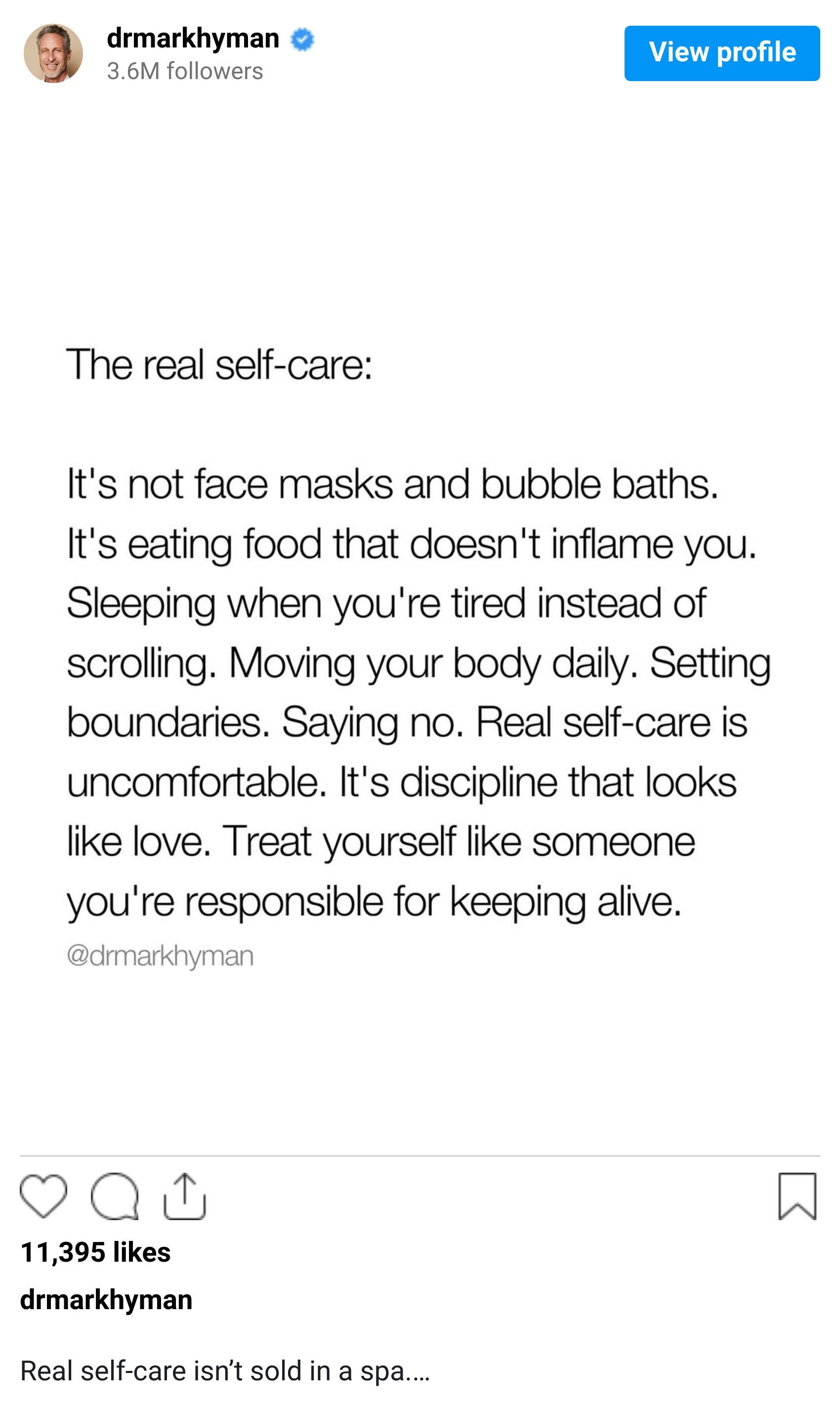
Share this with a fellow leader - we’re stronger together.
If this was forwarded to you, join hundreds of other top-level executives and entrepreneurs by subscribing here.
The Prime Performance Program
Designed by neuroscientists and INSEAD-trained coaches, our integrated performance system ensures you think, feel and lead to your full potential.
No false fixes. Real results.